
Beyond the Bad Beat
The Leak Audit
For cash-game and Rush & Cash players who want to know what's actually costing them. More hands, more data, more predictable opponents — online should be easier than live, not worse. If it isn't, there's a specific, findable reason. It's in your own hand history.
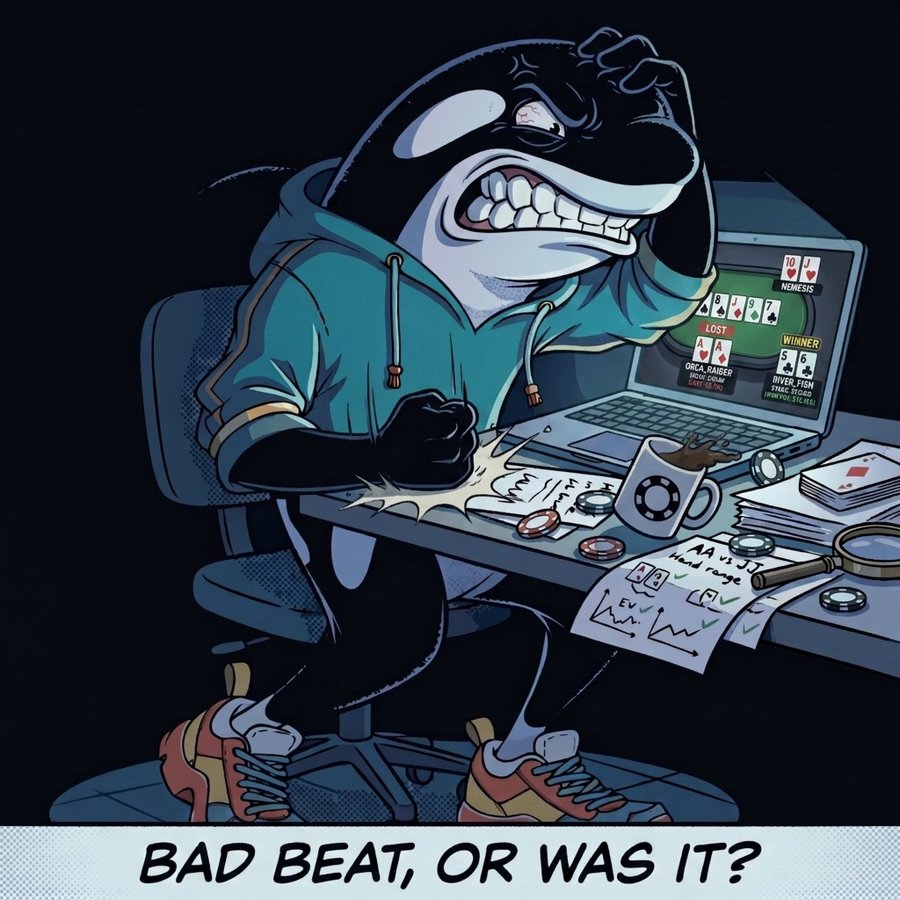
Wherever your graph is right now, there's a specific, findable reason it isn't better.
Live gives you the whole hand to think. Online, especially multi-tabling, the same decision gets a fraction of the time — habits that relied on unhurried reads start defaulting to autopilot.
No faces, no posture, no timing-in-the-room. The information that's left is sizing, frequency, and betting patterns across a sample — a completely different skill from reading a person.
Online opponent pools skew toward players who've studied solver output directly. Lines that exploited a typical live rec often don't hold up the same way.
A leak that cost little over a live player's smaller sample gets magnified across thousands more hands a year online — and it hides inside results, because folds cost nothing visible.

This is what actually happens to your file. Someone sits down with it — hand ranges pulled up, EV checked, notes written by hand — and goes through it decision by decision, the way you'd review a session with a coach who actually watched you play.
Not a dashboard glanced at for five minutes. Not a threshold an algorithm flags. An actual read-through, hand by hand.
7,142 of 8,514 big blinds folded before the flop — 84% of them. Defending only 16% of the time turns the one seat that already has money in the pot into the worst seat at the table by a distance, and folding every hand would only have cost twice as much.
14 hands where a river bet of 15bb or more — usually most of the pot — got called with one pair or worse. At NL5 a bet that size on the end is almost never a bluff. One of them: A-T on A-4-6-8-7, one pair of aces called into a completed straight, -71bb.
Five hands where a big turn bet or an all-in got called with a draw that didn't have the outs to justify the price. Two overcards and a backdoor isn't a draw — it's the shape that turns a lost pot into a lost stack.
33 hands. Every other class in the calling range beat folding — suited broadways, pocket pairs, suited connectors, big pairs. A2s-A9s were the sole exception, running 5.15bb per call worse than simply folding, dominated by the ace-heavy range that 3-bets at this stake.
Two hands, both the same shape: raise pre with A-K, miss the flop, get called on the turn, fire the river anyway into a player who had already called twice. Small in this sample — but it's the exact spot where "represent it" costs the most, and it only goes one way.
A real audit of a real 50,348-hand NL5 sample — every client report is built exactly the same way, entirely from your own file, with real hand examples cited for each finding.
These are 5 of the findings. Read the entire report, start to finish — the exact document a client receives.
Pull a hand history export from your site or tracker (Hold’em Manager, PokerTracker, or the site’s own export) — cash games or Rush & Cash. Whatever recent sample you have; pricing below scales with how many hands there are to review.
Before you send anything, write down — as thoroughly and specifically as you can — what you think is actually costing you money. Your real, reasoned guess, whatever it is. Send that along with the file.
A written, decision-by-decision report once every hand's been reviewed, checked against your own theory, plus a short written follow-up — or add a video call to walk through it together.
We're new, and this is our launch push: a handful of full-depth reviews done for free, no shortcuts, in exchange for an honest testimonial we can reference afterward — whatever it says. This covers your first 30,000 hands; if your file is bigger, we'll review the first 30,000 free and price the rest at the standard per-tier rates below. This is where the process gets proven out before anyone pays for it.
Once the free reviews are gone, pricing scales with hand volume — since a person is actually reading the hands, a bigger sample is genuinely more time, not a free extra for a script.
$35 for up to 30,000 hands, personally reviewed, works out to roughly $1.17 per 1,000 hands. The closest comparable service we could find — human-reviewed, not a stats scanner — starts at $599 with a 50,000-hand minimum, around $12 per 1,000 hands. We're new and building a track record, which is part of why the price is where it is right now, but hand for hand this is about as little as you'll pay anywhere for someone to actually read your hands rather than run them through software.
Guarantee — write your own thorough, specific theory of why you're losing money before you send your hands. If it turns out you were right, the report is free. If it's not the real answer, you'll get the one that is.
We're cash-game and Rush & Cash players ourselves, and we hold every review to one strict rule: no leak gets called without checking it against the actual hand data first — no generic ranges, no population assumptions asserted without verifying the sample.
That same standard is what we apply to your hands. Every finding in your report is something that shows up in your sample, cited with your own hand examples and checked against your own theory — not a repackaged strategy article.
No — and that's the point. The hands in your file are read by a person, decision by decision, not scored by an algorithm. If you're looking for an AI or leak-finder tool to scan your stats — like Kevixo, SplitSuit's LeakFinder, or Leak Buster — this is the alternative: those tools flag whatever pattern they're tuned to catch, the same way for everyone. Nobody here calls a leak without checking it against your actual hands first.
No. That's the transition we see most often, and it's a real pattern worth naming, but the audit works for any cash-game or Rush & Cash player who wants to know what's actually costing them — whether you're deep in the red, bleeding slowly, or already winning and want to find whatever edge is still on the table.
Online cash games and Rush & Cash (fast-fold) only, at any stake. Tournaments and sit-and-gos aren't part of this yet — send cash-game hands only, so the sample stays clean.
Typically 3–5 business days from when we receive your hand history export, depending on sample size — larger files take a little longer, since a person is actually reading every hand.
You still get the full report, with the real answer instead of the one you guessed. The guarantee only doesn't apply if the theory is skipped, or too vague to count as a real answer — something specific enough that we can actually check it against your hands.
Just the person doing your review. Your hands aren't resold, shared, or run through a third-party tool — they're read once, for your report.
We're new, and this is our launch push — a limited batch of full-depth reviews done for free, covering your first 30,000 hands, in exchange for an honest testimonial we can reference afterward (anonymously, if you'd prefer). Bigger sample? We'll review the first 30,000 hands free and price anything beyond that at standard rates. Once the free batch is gone, standard pricing applies to everyone.
© 2026 Beyond the Bad Beat. All rights reserved.
We use GoatCounter, a privacy-first analytics tool, to count page visits — no cookies, no cross-site tracking, no ad networks, no personal data sold. Hand histories are read once, by a person, for your report — never sold or shared.
Questions about your data? beyondthebadbeat@gmail.com